Summary:
• MIT researchers have created a lightweight polymer film that blocks almost all gases.
• This film could help prevent corrosion in solar cells and extend the shelf life of food and medicine.
• The material is stronger than steel for its weight and can be made in larger quantities than similar materials like graphene.
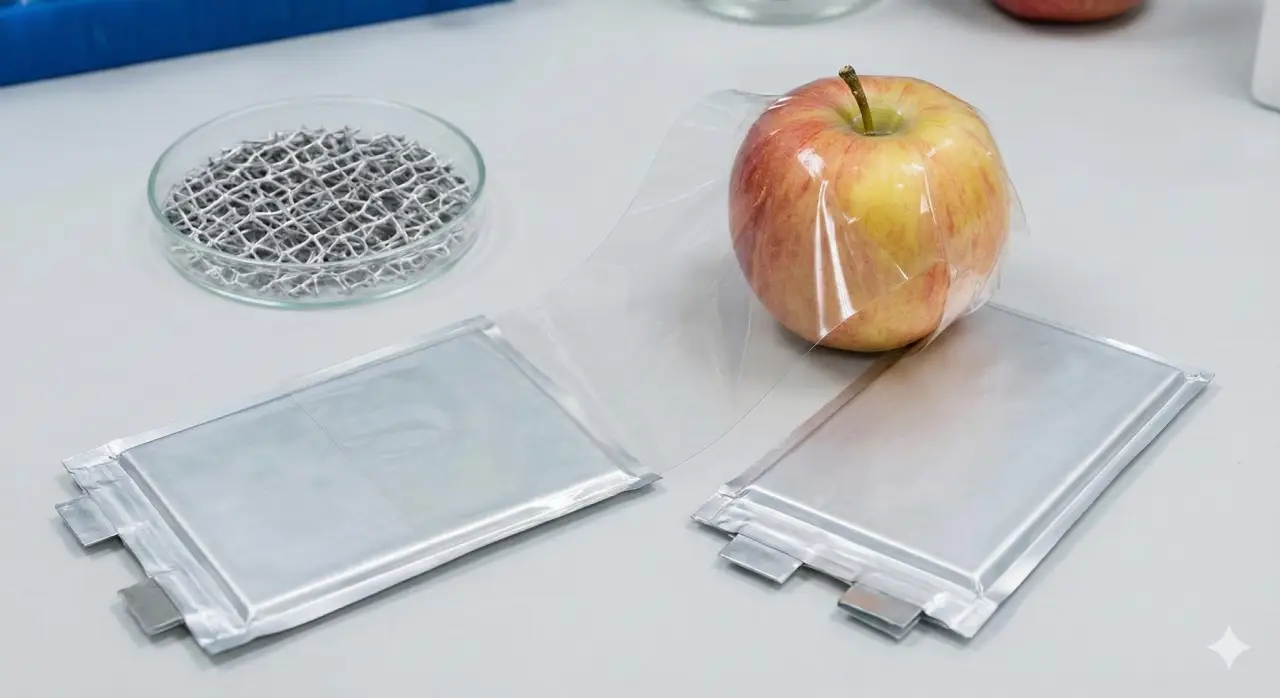
Imagine a protective coating so thin you can barely see it, yet so strong and airtight that it could keep food fresh for weeks or protect delicate electronics from the elements. Researchers at MIT have developed just such a material—a new polymer film that is nearly impossible for gas molecules to pass through.
What is this new material: The material is a type of polymer, which is a substance made from long chains of repeating molecules. Polymers are everywhere in daily life, from plastic containers to clothing. But most polymers allow small gas molecules, like oxygen or nitrogen, to slowly seep through. This is why food wrapped in plastic still goes stale over time.
The MIT team’s new polymer, called 2DPA-1, is different. It’s made from tiny disks that stack tightly together, leaving almost no space between them. This structure is held together by hydrogen bonds, which act like strong glue between the layers. The result is a film so dense that even the smallest gas molecules can’t find a way through.
How was it made: The researchers used a chemical called melamine to build the film. Under the right conditions, melamine molecules link up to form flat sheets just a few nanometers thick (a nanometer is a millionth of a millimeter). These sheets stack on top of each other, creating a strong, stable film.
Why does this matter: The new film is not only extremely thin and light, but also stronger than steel for its weight. Most importantly, it is almost completely impermeable to gases. In tests, the researchers made tiny bubbles out of the film and filled them with gases like nitrogen and helium. Unlike ordinary plastic bubbles, which quickly deflate, these bubbles stayed inflated for years.
This level of gas blocking is rare. In fact, the only other material known to be this impermeable is graphene—a single layer of carbon atoms arranged in a crystal. But making large sheets of graphene is difficult and expensive. The new polymer can be produced in larger quantities and applied more easily.
What could it be used for: Because it blocks gases so well, this film could be used to protect all sorts of things. For example:
– Solar cells: Many new solar panels are made from materials that degrade quickly when exposed to air. A thin layer of this polymer could keep out oxygen and water, helping the panels last longer.
– Food and medicine packaging: The film could keep out air and moisture, extending the shelf life of packaged goods.
– Infrastructure: Bridges, vehicles, and buildings could be coated to prevent rust and corrosion.
– Electronics: The film could help make tiny, powerful devices like sensors and resonators, which are used in cell phones and other technology.
What’s next: The researchers are excited about the possibilities, but more work is needed before the film can be widely used. They are studying how to make thicker coatings for even better protection and exploring new uses in electronics and other fields. This breakthrough shows how new materials can solve everyday problems, from keeping our food fresh to making our technology last longer.
This research was published in Nature by senior authors Michael Strano (MIT) and Scott Bunch (Boston University), with lead authors Cody Ritt (University of Colorado at Boulder), Michelle Quien (MIT), and Zitang Wei (MIT).