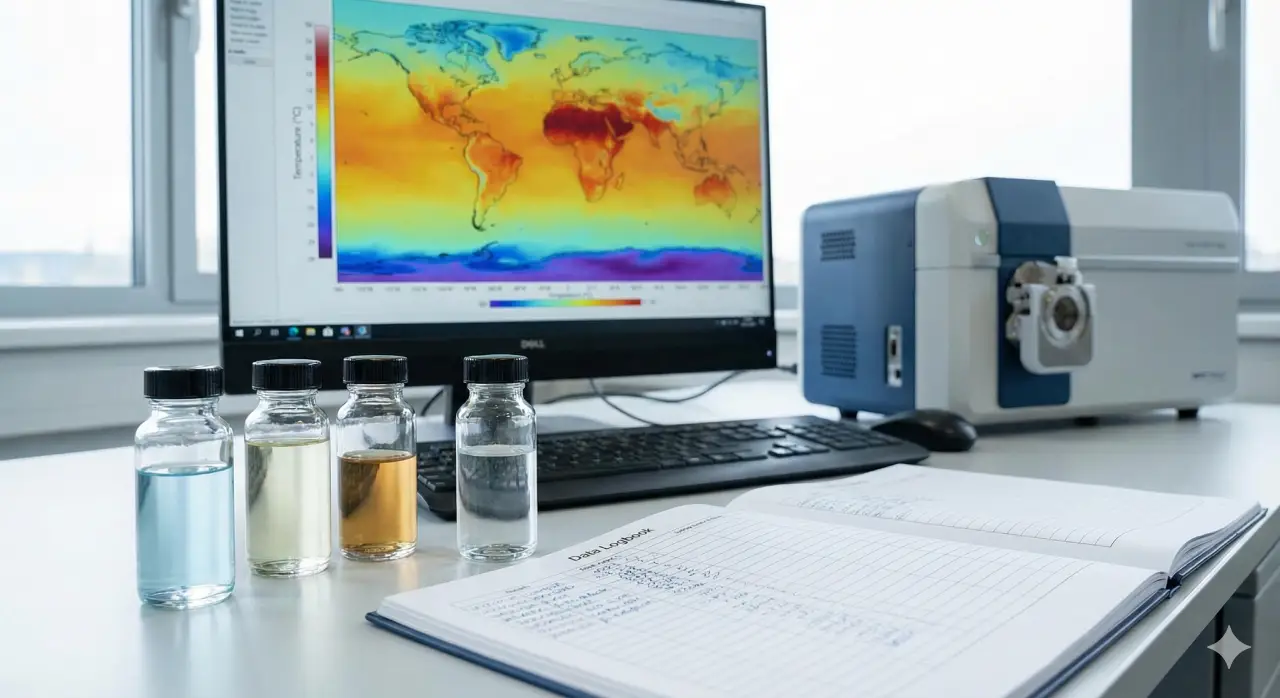
Introduction: Water may appear identical wherever it flows, but at the molecular level, it carries a unique chemical signature. These signatures, known as water isotopes, act like natural fingerprints that reveal where water comes from, how it moves through the environment, and how climate change is reshaping the global water cycle. By studying water isotopes, scientists can validate climate models, reconstruct past climates, and assess future climate risks with greater confidence.
What Are Water Isotopes: A water molecule is made of hydrogen and oxygen, but these elements exist in slightly different forms called isotopes. Some water molecules contain lighter isotopes, while others contain heavier versions such as oxygen eighteen or deuterium. Although these differences do not change how water behaves chemically, they strongly influence how water evaporates, condenses, and falls as rain or snow.
Lighter water molecules evaporate more easily, while heavier ones condense more readily. This process, known as fractionation, creates distinct isotopic patterns in rain, snow, groundwater, rivers, and glaciers. Each drop of water, therefore, carries information about the temperature, altitude, and atmospheric conditions under which it formed.
Tracing the Origin of Water Sources: Water isotopes act as natural tracers within the water cycle. By measuring the ratio of heavy to light isotopes, scientists can identify the origin of water sources. Rainfall from cold regions has a different isotopic signature than rain from warm tropical areas. Groundwater can be traced back to ancient rainfall, recent precipitation, or mountain snowmelt.
This allows researchers to determine whether rivers are fed mainly by glaciers, seasonal rainfall, or underground aquifers. It also helps estimate how long water has been stored underground before reaching wells or springs, which is essential for understanding water availability and sustainability.
Understanding the Water Cycle Through Isotopes: As water moves from oceans to clouds, from clouds to land, and back to rivers and seas, isotopes change in predictable ways. Evaporation enriches lighter isotopes, while condensation favors heavier ones. Tracking these changes allows scientists to map moisture transport across regions and continents.
This detailed view of the water cycle goes beyond traditional measurements such as rainfall amount. Isotopes reveal where moisture originated and how it travelled, offering deeper insight into climate variability and long-term climate change.
Improving Climate Models: Climate models are complex computer simulations used to predict future temperature, rainfall, and circulation patterns. Water isotopes provide real-world data to test and improve these models. Scientists now use isotope-enabled climate models that simulate isotopic behaviour alongside atmospheric processes.
By comparing modelled isotope patterns with real measurements from rainfall, ice cores, caves, and satellites, researchers can identify weaknesses in how models simulate clouds, storms, and moisture transport. When models accurately reproduce isotope patterns, confidence in their future climate predictions increases.
Assessing Climate Risk: Water isotopes link past climate behaviour with future risk. Ice cores preserve isotope records that allow scientists to reconstruct temperatures and climate conditions over hundreds of thousands of years. These records reveal how the climate responded to past changes in greenhouse gases, helping estimate future warming sensitivity.
In the present day, isotopes help diagnose water-related risks. They can identify changes in rainfall sources, increasing evaporation, or declining snow and glacier contributions. Isotope analysis of extreme rainfall events also helps scientists understand storm intensity and flood risk. For water-stressed regions, isotopes provide early warning signals of drought and declining water security.
Applications in Water Resource Management: Beyond climate science, isotope analysis supports sustainable water management. It helps identify groundwater recharge zones, prevent over extraction, and distinguish renewable water from fossil water that cannot be replenished. These insights are critical for managing water supplies under increasing climate pressure.
Conclusion: Water isotopes are powerful tools that reveal the hidden story of the water cycle. By tracing water origins, strengthening climate models, and improving climate risk assessment, isotope science plays a vital role in building climate-resilient and sustainable water systems for the future.