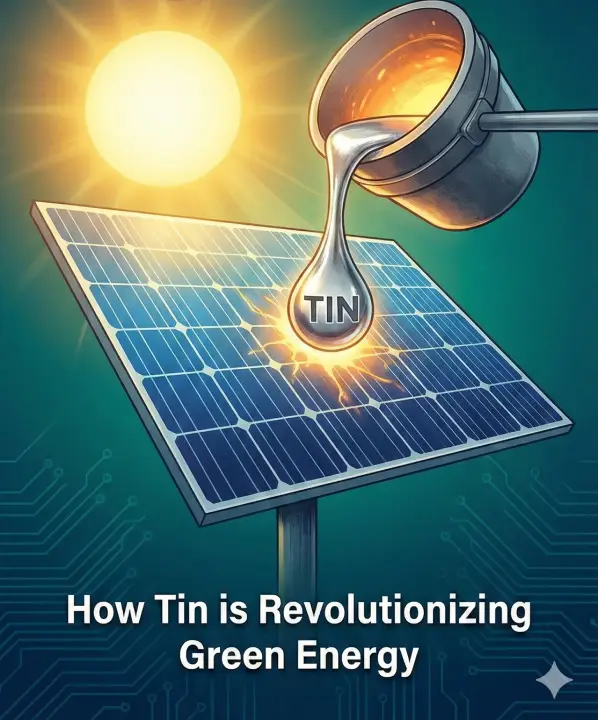
The quest for the perfect solar panel often feels like a balancing act between efficiency, cost, and environmental impact. While traditional silicon panels have served us well, the future belongs to perovskites—a new class of materials that are cheaper and easier to manufacture. Among these, Tin-based Perovskite Solar Cells (TPSCs) are the rising stars, celebrated for being environmentally benign compared to their lead-based counterparts.
However, tin has always had an Achilles’ heel: stability. To make these cells efficient, scientists typically add “seasoning”—small-molecule additives—to the material mix. Unfortunately, these additives often act like a weak link, causing the crystal structure to deform or degrade rapidly under heat and electricity. This has kept tin-based solar from reaching its full commercial potential.
A New Recipe for Stability: A recent breakthrough has flipped the script on how we build these cells. Instead of relying on external additives that wear out, researchers have developed a strategy called A-Site Compositional Engineering. Think of it as changing the cake batter recipe itself rather than just putting frosting on top.
By tweaking the intrinsic components of the material, scientists have successfully controlled how the perovskite crystals grow (nucleation) and align. This “additive-free” approach promotes a much cleaner, more robust crystal structure, forming a protective two-dimensional phase that naturally shields the cell from degradation.
Breaking Efficiency Records: The results of this new design are turning heads in the energy sector. This modified “intrinsic” approach has boosted the power conversion efficiency of tin solar cells from 10.22% to a remarkable 13.49%.
Even more impressive is the durability. In testing, these new cells showed negligible loss of efficiency after being stored for 5,800 hours (nearly 8 months) in a nitrogen environment. This proves that we don’t need unstable additives to achieve high performance; we just need a better blueprint.
As we look toward a net-zero future, innovations like this are critical. They bring us one step closer to solar panels that are not only powerful and long-lasting but also truly safe for the planet.