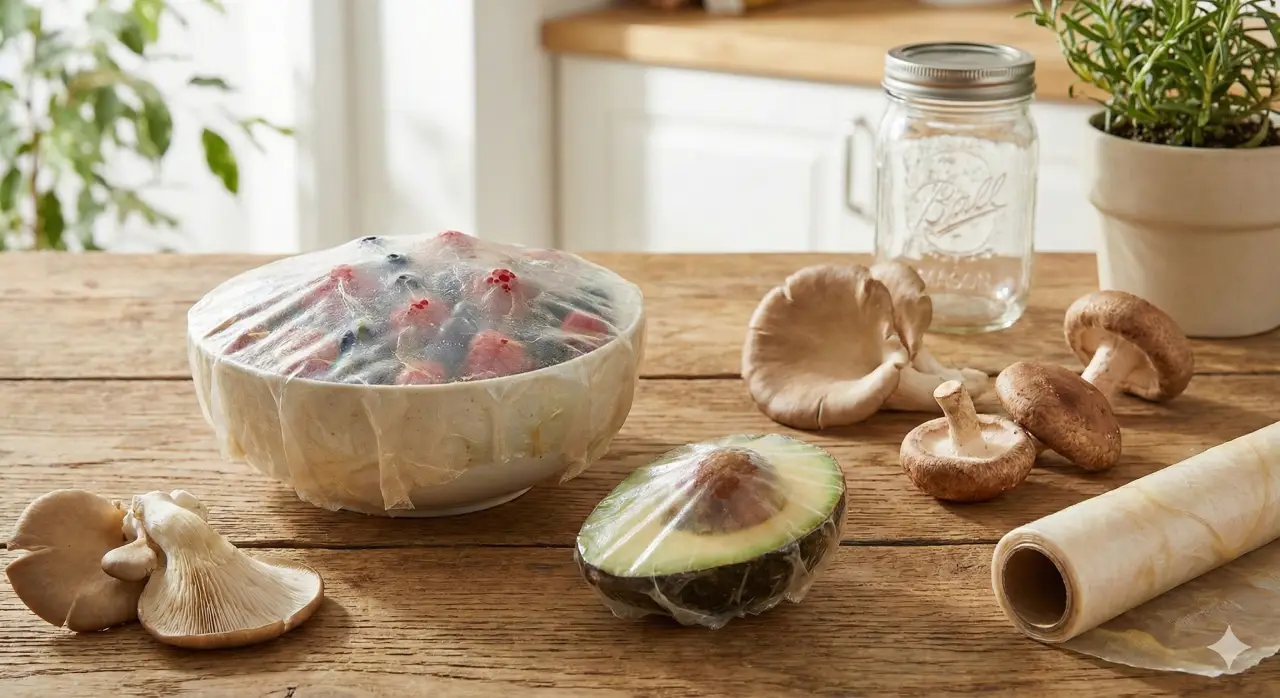
In the fight against single-use plastics, the most sophisticated solutions often come from the forest floor rather than a chemical lab. We are all familiar with the plastic coatings that line our coffee cups and the cling wrap that covers our leftovers. While convenient, they contribute massively to landfill waste. However, researchers have unveiled a new, edible alternative derived from a surprising source: the “turkey tail” fungus.
A Living Shield: Fungi are more than just the mushrooms we see above ground; their true power lies underground in a vast, feathery network of filaments called mycelium. Because mycelium naturally repels water, scientists have begun exploring its potential to create sustainable barriers.
In a proof-of-concept study published in ACS Langmuir, researchers combined this fungal network with cellulose nanofibrils—the fluffy microscopic fibers used in paper-making. The goal was simple yet ambitious: to grow a food-safe, natural film that could block water, oil, and grease just as effectively as synthetic plastic.
The Growth Process: The process is a marriage of biology and engineering. The team blended the Trametes versicolor (turkey tail) mycelia with a nutrient-rich wood fiber solution and applied it to common materials like paper, denim, and thin wood. Instead of drying instantly like paint, this coating is alive—at least for a few days.
The samples were left to grow in a warm environment. After at least three days, the fungus formed a tight, protective barrier. Once the network was established, the materials were baked in an oven to inactivate the fungus and dry the coating.
Performance with a Natural Patina: The results were visually and functionally striking. The fungal coating, which is about as thin as a layer of paint, transformed the materials, giving them mottled patterns of yellow, orange, and tan. More importantly, it worked.
When researchers placed water droplets on the treated denim and paper, the liquid formed bead-like spheres rather than soaking in. The coating even resisted tough liquids like oil and grease, proving it could handle the demands of food packaging.
As Caitlin Howell, the study’s corresponding author, beautifully puts it, “Nature offers elegant, sustainable solutions” to help us reduce our reliance on single-use plastics. By turning to the biological intelligence of fungi, we may soon wrap our sandwiches in materials that are as safe for the ocean as they are for our lunchboxes.