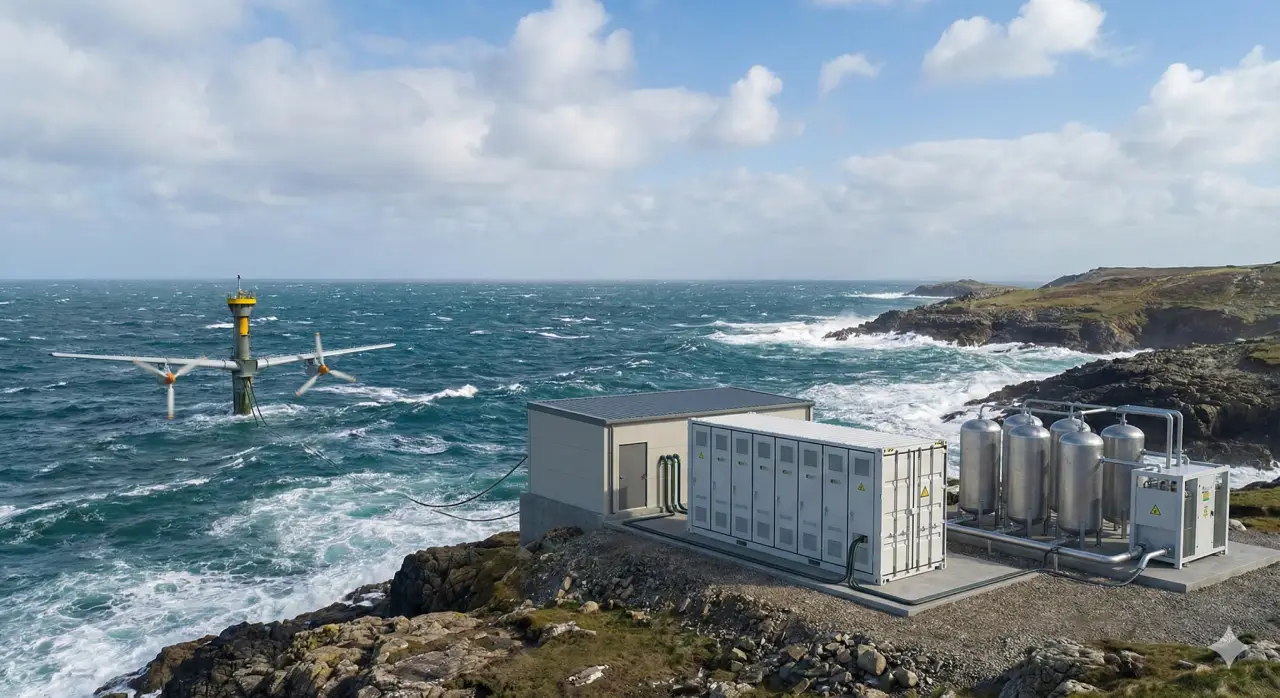
Image for Illustrative Purposes Only.
Summary:
• A unique project in Scotland combined tidal energy, battery storage, and hydrogen production for the first time.
• The system helps smooth out tidal energy’s ups and downs, making renewable power more reliable.
• This approach could help coastal areas use more clean energy, even when the electricity grid is limited
In a world-first demonstration, engineers in Orkney, Scotland have successfully combined three cutting-edge clean energy technologies: tidal power, battery storage, and hydrogen production. This achievement shows a new way to make renewable energy more flexible and reliable, especially for coastal communities.
What Was Demonstrated: The project took place at the European Marine Energy Centre (EMEC) on the island of Eday. It brought together three main technologies: – The O2 tidal turbine, which generates electricity from the movement of ocean tides – Vanadium flow batteries, which can store and release large amounts of energy – A hydrogen electrolyser, a device that uses electricity to split water into hydrogen and oxygen
How Does the System Work: Tidal energy is very predictable, but it comes in cycles—there are times when the tides are strong and generate lots of power, and times when they are weak. This can make it hard to use tidal power on its own for things that need a steady supply of electricity.
The new system solves this problem by using batteries and hydrogen production together with tidal power. When the tidal turbine produces more electricity than needed, the extra power is stored in the batteries or used to run the hydrogen electrolyser. The electrolyser turns electricity and water into hydrogen gas, which can be stored and used later as a clean fuel.
When the tides are low and the turbine isn’t generating much power, the batteries can supply electricity to keep the hydrogen electrolyser running. This keeps the whole system working smoothly, even when the tides change.
Why Is This Important: By combining these three technologies, the project shows how renewable energy can be made more reliable and flexible. This is especially useful for islands and coastal areas, where connecting to the main electricity grid can be difficult or expensive. The hydrogen produced can be stored for long periods and used in many ways, such as powering vehicles or making synthetic fuels for ships and planes. This could help reduce pollution in sectors that are hard to electrify.
What Did the Demonstration Achieve: The team tested several ways of running the system and found that it could respond quickly to changes and keep everything running safely. They also learned valuable lessons about how to manage the batteries and control the electrolyser, and saw that more automation could make the system even more reliable.
The demonstration was supported by Scottish and European funding, and experts say it could be a model for other places looking to use more renewable energy.
What’s Next: The success of this project opens the door to new ways of using tidal energy, especially in places where the electricity grid can’t handle more power. It also points to future uses for hydrogen, such as making clean fuels for transport. As the world looks for more ways to cut carbon emissions, combining tidal power, batteries, and hydrogen could become an important part of the solution for clean, reliable energy.
This demonstration was led by the European Marine Energy Centre (EMEC) and involved Orbital Marine Power, Invinity Energy Systems, and ITM Power. It was part of the ITEG project funded by Interreg North-West Europe, with additional support from the Scottish Government via Highlands and Islands Enterprise, and the EU-funded FORWARD2030 project.